
Choosing between a phone and a professional videographer comes down to four questions: Who is watching? How critical is the audio? What does average footage say about your brand? And how long does the content need to last? For internal or short-lived content, a phone works fine. For customer-facing videos where audio quality, brand perception, and shelf life matter, professional production is the right call. Businesses filming in Saudi Arabia should also factor in film permit requirements from the start, regardless of the equipment they use.
Before your next video production, stop and ask yourself one question: who is actually watching this video?
That one question changes every production decision that follows. It determines the equipment, the crew, the timeline, and the difference between a video that builds trust and one that silently loses it.
We help businesses across Saudi Arabia navigate film permits and video production decisions every day. The most common mistake we see is not about resources. It is about matching the production level to the purpose, and most businesses skip that conversation entirely.
The short answer is this: if your video is being seen by potential customers, audio quality is non-negotiable, and you need the content to perform for months rather than days, hire a professional videographer. If your video is internal, low-stakes, and needed tonight, your phone can handle it. Everything in between depends on how you answer four specific questions.
It rarely has anything to do with how polished your setup looks.
The most important filter in any video production decision is the audience. A video seen only by your internal team carries very different stakes than one seen by potential customers who have never heard of your brand.
When a potential customer watches your video, they are not just processing the message. They are reading the production quality as a signal of your company's standards. A study by Wyzowl found that 89% of people say watching a brand's video convinced them to make a purchase, but that persuasion effect depends entirely on whether the video builds confidence or quietly undermines it.
Here is a simple way to think about it:
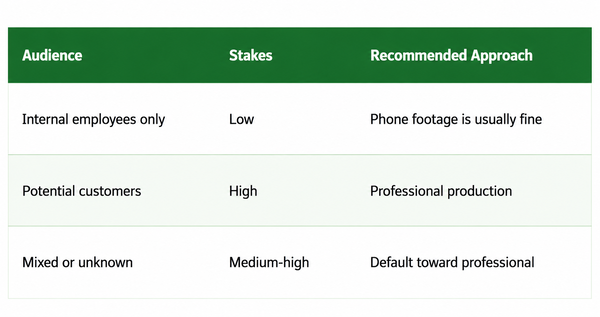
If your audience is potential customers, the bar for production quality goes up immediately. A cinematic videographer in Saudi Arabia brings the framing, lighting, and storytelling consistency that customer-facing content demands.
If you are not certain who will see the video, assume your most important customer will see it.
This is where most businesses make the first wrong turn. They plan for the easy case and get surprised when the video ends up in front of the wrong audience.
Viewers will forgive average visuals far more quickly than they will forgive bad audio.
This is the finding that surprises most business owners. Facebook's own internal research showed that 80% of people react negatively to poor audio in video content, even when the visuals are strong. Audio quality is not a production bonus. It is a baseline trust requirement.
The question to ask yourself is straightforward: is audio "nice to have" for this video, or is it business-critical?
For internal updates, quick announcements, or behind-the-scenes content shared informally, phone audio with a decent environment will work. For product demonstrations, client testimonials, brand films, event coverage, or anything going into a paid campaign, business-critical audio means professional microphones, controlled environments, and post-production sound design.
A professional videographer does not just bring a camera. They bring a complete audio setup that your phone's built-in microphone cannot replicate. When the message of your video matters, the delivery of that message matters equally.
If you need a crew that handles both the technical and creative side of a commercial production, working with a TV commercial film crew in Riyadh ensures the audio, lighting, and direction are production-ready from day one. The regret from reshooting a video because the audio was unusable is always avoidable when the right crew is brought in from the start.
Most businesses underestimate the silent damage that average-looking footage does to brand perception.
When a video looks average, it does not simply fail to impress. It actively communicates something. It tells the viewer that the brand either does not notice the difference or does not think the audience is worth the investment.
Professional videographers do not just capture footage. They frame your brand. Lighting, color grading, shot composition, and visual consistency are not aesthetic preferences. They are signals that either confirm or undercut everything your sales team is trying to build.
"The right choice is not about the camera. It is about the outcome."
If your footage looks average, nobody outside your team will say it out loud. They will simply move on.
The shelf life of your content is one of the most practical filters in this decision.
Phone content is built for speed. It is raw and immediate and works well in contexts where timeliness matters more than polish: a live event update, an impromptu message from a founder, or a social story that disappears in 24 hours.
Professionally produced content is built for longevity. A well-shot brand film, a product showcase, or a corporate testimonial is a reusable asset. It lives on your website, anchors your pitch deck, and works for months or years without feeling dated.
When you commission professional video production in Saudi Arabia, you are not just booking a shoot. You are building a content asset that works for months or years without feeling dated. A phone video, no matter how well executed, has a natural ceiling on how long it can credibly represent a professional brand.
Ask yourself this: if this video is still live on your website 12 months from now, will it still make the right impression? If the answer is uncertain, a professional videographer is the safer choice.
Use the answers to these four questions as your decision framework:
If you answered B on most of these, hire a videographer. If you answered mostly A, your phone is enough for this specific piece of content.
The framework is not about doing more. It is about doing the right thing for the right purpose.
There is one more consideration that many businesses in Saudi Arabia overlook entirely.
Professional video production in the Kingdom, particularly for commercial campaigns, public-facing content, or content shot in regulated locations, often requires a film permit. Filming without the correct permissions can result in fines, confiscated equipment, and content you cannot legally use or publish.
This applies whether you are using a professional crew or a phone. The permit requirement is tied to the filming activity and location, not the equipment.
Working with a team that understands Saudi film permit requirements from the start protects your production timeline. A shoot that gets stopped mid-day due to a missing permit creates delays that no amount of planning can recover from quickly.
The businesses that run a campaign and still get poor results usually did not make the wrong choice between a phone and a videographer. They made no choice at all.
They defaulted to whatever was convenient, hoped the content would perform, and discovered too late that the production decision had already determined the outcome before the campaign launched.
Professional content does not guarantee results. But average content in a competitive market almost guarantees you will not stand out.
The question is never really "phone or videographer?" It is "what outcome does this video need to produce?" Once you are clear on that, the production decision makes itself.
If you are planning a video production in Saudi Arabia and want to make sure your permits, crew, and content strategy are aligned from day one, explore how we can help.
The core difference is not image resolution. It is the combination of controlled audio, professional lighting, color grading, and shot composition that builds brand credibility. Professional video equipment and crew deliver a consistency that phone footage cannot replicate, particularly for customer-facing content that needs to perform over a long period.
Answer four questions: Who will watch the video? Is audio quality critical to the message? Will average footage reflect badly on the brand? Does the content need to perform for weeks or months? If the answer to any of these points toward customer-facing, high-stakes, or long-shelf-life use, professional production is the right call.
Phone footage works well for internal communications, behind-the-scenes content, social stories with a 24-hour lifespan, and founder-led updates where authenticity matters more than production polish. It also works as a supplementary layer in professionally produced videos. The key is intentionality. Phone footage used as a deliberate creative choice performs very differently from phone footage used because the professional option was not considered.

